A television console is already a complicated living-room product. It needs to look proportionate beneath a screen, hold media equipment, manage cables, survive daily cleaning and arrive in a carton that a customer can carry and assemble. Adding a cat resting nook, passage or scratch surface does not simply add a “pet feature.” It changes the space plan, the access routes, the material specification and the sample-review process.
For brands, importers, retailers and hospitality buyers, the strongest direction is furniture first: a well-resolved console whose cat functions are intentional, serviceable and easy to explain. This guide sets out the questions to answer before a cat-integrated TV console moves from concept image to quotation, sample and production brief.
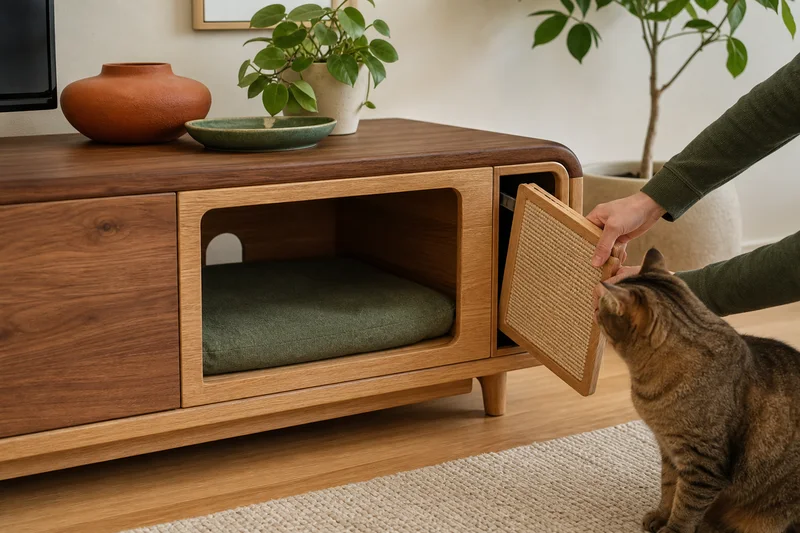
Start with a furniture brief, then assign the cat function
“Cat-friendly TV stand” is too broad for a factory quotation. Write the human use first: screen width, equipment to store, visible versus concealed storage, preferred viewing-room style, maximum wall width and desired height. Then choose one primary cat function rather than putting every idea into one cabinet.
- Resting nook: a low, open retreat with a removable cushion.
- Pass-through: a clear opening that lets the cat move through a low cabinet module.
- Scratch zone: a replaceable panel located where the owner can see and reach it.
- Low perch: a top or step-like area only when the intended cat use, construction and room placement are defined.
These functions can be combined, but each consumes usable volume. A console cannot at the same time provide full-depth media storage, a generous cat cavity, large drawers and a very slim exterior without a trade-off. A good initial brief states the priority and the acceptable compromise before finishes or hardware are selected.
1. Plan access, not just a decorative hole
A cat opening needs a real route: entry, turning space, resting space and a way back out. Avoid treating the visible front opening as the whole cat zone. Internal dividers, rear cable boards, cushions and door hardware can reduce the usable cavity far more than the exterior drawing suggests.
Feline environmental guidance identifies a safe place and the ability to observe from elevated or raised areas as important needs; where a cat can be threatened, the safe place should offer access from at least two sides. That does not mean every TV console needs two openings. It means the product team should assess the intended room, nearby traffic, other pets and the actual route through the chosen module instead of assuming a single closed-end cavity suits every home. See the FelineVMA environmental-needs guidance for the underlying welfare context.
For a resting nook, document usable width, depth, internal height, entry height and cushion thickness separately from the overall cabinet. For a pass-through, show both openings and the clear internal route. The target cat profile must be part of the brief. Do not make a blanket claim that one cavity is suitable for all adult cats, multi-cat homes or pets with mobility needs.
2. Keep the resting nook quiet and serviceable
The most convincing cat nook feels like a deliberate low retreat, not a dark leftover space between drawers. Place the cushion where it can be removed without moving the TV unit or disassembling the cabinet. Check the front edge, back board, cable hole and divider positions for snag points. If an owner cannot lift the cushion out easily, routine cleaning becomes a frustration and the interior will quickly look neglected.
The cushion specification needs the finished dimensions, cover material, filling or foam direction, closure method and underside. If the cover is described as removable or washable, confirm that statement only after the selected textile, zip, seam placement and care test are approved. An optional replacement cushion can be a useful aftermarket item, but it should be designed as a real SKU rather than promised vaguely during concept development.
3. Treat scratching as a replaceable wear component
Scratching is a normal feline behavior, yet individual cats can prefer different orientations and surfaces. The practical product response is not to claim that one texture will suit every cat. Instead, give the buyer a clear material option and a replacement route. The Cat Friendly Homes scratching guidance recommends offering suitable scratching surfaces and notes that cats can have distinct vertical or horizontal preferences.
For a TV console, a framed sisal, carpet or other approved scratch panel should be located away from sharp outer corners and clear of cabinet-door swing. Specify its exposed size, backing board, edge treatment, fixing method and removal direction. A recessed module with screws accessible from the inside or a controlled slide-out route is generally easier to service than a permanently glued decorative panel. Test the replacement step on the sample: can one person remove it without scratching the finished wood or taking apart the console?
4. Separate cat space from electronics and cable management
Media storage is not simply empty volume. Soundbars, game consoles, routers and power components may require access, ventilation and a clear cable path according to the equipment maker’s instructions. The cat zone should not double as an uncontrolled cable cavity. On the drawing, show the cable-entry and exit points, removable back-panel sections, equipment compartment, cat compartment and all dividers.
Do not make generic safety, ventilation or electrical-compliance claims from a furniture concept. The final configuration must be reviewed against the actual devices, target market and any applicable requirements. In practice, keeping the cat resting area physically separate from media equipment makes the furniture easier to use, clean and explain to retailers.
5. Use material specifications that match the destination market
“Wooden console” is not a bill of materials. A quotation package should identify the substrate, solid-wood or veneer components, finish system, edge treatment, backing board, feet, scratch-panel construction, cushion textile and hardware. It should also identify which parts receive the most contact: the cat opening, cushion base, scratch-panel frame, top surface, doors and carton-facing corners.
For products sold in the United States, the EPA’s TSCA Title VI FAQ identifies hardwood plywood, MDF and particleboard as regulated composite wood products, including finished goods that contain those regulated panels. Buyers and suppliers should confirm the requirements that apply to the final material route, certification, records and labeling. A rendering, a generic “eco” statement or a supplier email is not compliance evidence.
6. Build flat-pack logic into the first engineering review
Flat-pack can improve container efficiency, but only when panel sequence and customer assembly are considered from the start. The console usually has a long top, two sides, base, internal divider, back panel, legs or plinth, doors or drawers, cat cushion and scratch panel. These parts need a clear pack order and a connector plan that does not force the customer to hold a heavy top while trying to align hidden fittings.
Use labelled hardware packs and distinguish visually similar left/right or front/back panels. Keep every connector reachable in the planned order. A person who did not design the product should assemble the pilot sample using only the instruction sheet. Their hesitation points—reversed panels, unclear cam direction, an inaccessible screw or a part fitted too early—are valuable engineering feedback, not merely manual-design issues.
7. Design the carton around finished surfaces and distribution
TV consoles often have long visible edges, large finished panels, legs, hardware and multiple small accessories. The packaging design should stop components rubbing together, prevent the hardware pack from damaging a face panel and protect the top and scratch-panel frame from impact. If a cushion is included in the main carton, it also needs to remain clean, dry and separate from hard components.
For individual packaged products distributed through a parcel system at 150 lb (70 kg) or less, ISTA Procedure 3A is a commonly referenced general-simulation procedure. It addresses distribution hazards such as vibration, drops and conditioning. The appropriate procedure, sample count and pass/fail criteria still depend on the actual product, packaging and delivery route; a result applies to the tested pack configuration, not every possible shipment event.
Use three approval gates before release
| Gate | Decision | Review points |
|---|---|---|
| Concept and quotation | Is the direction commercially viable? | Overall footprint, screen context, storage mix, primary cat function, target pet profile, material direction and target price. |
| Functional sample | Does the furniture work in daily use? | Usable cat cavity, cushion removal, scratch-panel replacement, door/drawer movement, cable route, edges, stability and assembly sequence. |
| Pre-production / packed sample | Is the confirmed order specification complete? | Approved finish, hardware, inspection points, instructions, carton, labels, replacement parts and distribution plan. |
What to send with a quotation request
- Reference photos, sketch or product link, plus maximum width, depth and height.
- Screen size and the equipment to be stored or concealed.
- The intended cat function: resting nook, pass-through, scratch zone or low perch.
- Target cat profile and required usable internal dimensions.
- Preferred wood, veneer or panel direction; finish reference; cushion textile; scratch-panel material; hardware style.
- Destination market, expected quantity, target price, flat-pack preference and shipping route.
- Any retailer testing, inspection, labeling or carton-size requirements.
Frequently asked questions
Can the TV console include a cat bed and a scratch panel?
Yes, if the two functions have separately usable space and a clear service path. Confirm the interior dimensions, cushion removal, scratch-panel fixing and storage trade-offs through the drawing and sample.
Is a cat-integrated console suitable for every cat?
No. Suitability depends on the individual cat, the intended function, the room and the finalized dimensions. Define the target pet profile rather than making a universal claim.
Can it ship in one flat-pack carton?
It may, depending on dimensions, panel layout, component protection and route. The carton must be developed and validated with the actual finished configuration.
Where can I explore related product directions?
View our cat-integrated furniture range, including the cat activity TV console, cat climbing bookcase and dresser with cat climbing module. For a tailored program, see our custom development process or send a product brief.
Sources: FelineVMA environmental-needs guidance, Cat Friendly Homes scratching guidance, U.S. Environmental Protection Agency TSCA Title VI composite-wood FAQ and International Safe Transit Association test-procedure overview. This article is a product-development guide, not a certification, safety or legal statement. Final dimensions, construction, materials, electrical clearances, packaging and market requirements must be confirmed for the actual product before production.