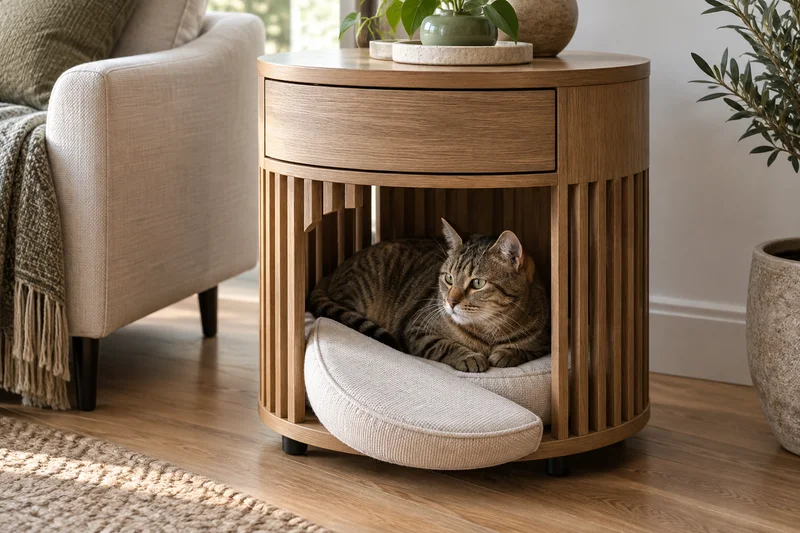
A round pet bed side table earns its place when it works as a genuine sofa-side or bedside piece of furniture and gives a cat or very small dog a clearly defined open resting nook. The rounded silhouette can soften a room more effectively than a rectangular cabinet, while a shallow drawer, usable top and removable cushion keep the human function visible. But the circular form also changes the product-development task: a curved shell, slatted opening, drawer, cushion and base must all be specified as a system rather than copied from a square side table.
For brands, importers and retailers, this is a category where an attractive render can hide expensive problems. A curve can be hard to veneer consistently; slat spacing can become irregular; a drawer can bind; a cushion can occupy more of the opening than planned; and a round carton can waste space if the packing plan arrives too late. This guide turns those risks into a reviewable brief before sampling. It does not claim that one bed shape suits every pet or that a furniture concept alone provides a universal safety or welfare outcome.
Begin with the sofa-side furniture brief
Start with the human role. Is the piece intended for a sofa end, reading chair, bed or hospitality lounge? Record maximum diameter, overall height, usable tabletop area, lamp footprint, drawer capacity, cable needs if any, nearby walking clearance and the likely view from a seated position. “Round” is not a complete dimension: the usable top, curved drawer face, pet opening and base ring all use different parts of the diameter.
Then describe the intended pet nook as a separate component. Record clear internal width, depth and height; opening width and height; cushion thickness; entry direction; interior finish; and how the owner removes the cushion. An outer diameter does not tell a buyer whether the usable nook is appropriate for the intended pet profile. Avoid vague claims such as “fits all cats” or “perfect for small dogs.” A final product should state its confirmed dimensions and let the customer make an informed choice for the individual animal.
1. Choose the curved construction route before quoting
There are several ways to produce a rounded table, and they do not carry the same cost, finish or packing consequences. A bent plywood or curved veneer shell can create a continuous furniture surface; a faceted panel construction can approximate a circle with repeatable flat parts; and a slatted outer cage can wrap an inner structure. The development pack should identify which surfaces are truly curved, which are structural, which receive veneer or paint, and which remain visible from the open pet nook.
Ask for a section drawing through the top, drawer, opening, base ring and slat zone. It should show material thickness, curved radius, backing panel, fastening direction, edge treatment and any internal frame. Without that drawing, suppliers may price visually similar but structurally different solutions. A curved cabinet is not automatically stronger, smoother or more expensive; the construction, materials and approved sample determine the result.
2. Make the open resting nook easy to understand and service
The opening is both a visual signature and a service point. Decide whether it is one wide front opening, a partial side opening, or a deliberate combination of open front and side slats. State the finished opening edge, the relationship of slats to the entrance, the visibility of the interior from the room, and whether the cushion is fully removable. Do not describe slats as “ventilation” unless the product’s actual air-flow and intended use have been defined and validated; in most furniture briefs, they are simply a design and openness feature.
For the cushion, specify finished diameter or crescent shape, thickness, fabric, fill, lower surface, edge binding, attachment method and care language. If it is described as washable, confirm that only after the selected textile, closure and care process have been approved. Test removal through the real opening, not by placing the cushion in the cabinet before the outer shell is assembled. The customer should not need to tip a finished side table or dismantle slats to remove a service part.
3. Keep the drawer separate from the pet opening
A shallow drawer gives the side table its furniture credibility, but it should have its own defined volume and runner plan. Record drawer width at the curved face and at the internal box, drawer height, bottom material, pull or finger notch, runner type, travel, stop, closing clearance and how it sits above the pet nook. A curved front can be decorative while the drawer box remains rectangular; this needs to be explicit in both the drawing and assembly sequence.
Review the functional sample with the drawer closed, partly open and fully open; cushion installed and removed; and table positioned next to the intended sofa or bed. Check the access route, front alignment, finger clearance and whether the open drawer changes the usable space around the furniture. Select hardware for the approved tray and drawer configuration, not a generic cabinet assumption.
4. Specify the material and finish component by component
“Oak pet side table” is not a bill of materials. A procurement sheet should separately list the structural substrate, curved shell, face veneer or laminate, solid-wood slats, top, base ring, drawer front, interior surfaces, coating, cushion textile, cushion filling, feet and hardware. That distinction lets buyers compare natural oak veneer, smoked finish, painted shell and mixed-material options without unintentionally changing the visible effect or the service parts.
For products supplied to the United States, the U.S. Environmental Protection Agency identifies hardwood plywood, MDF and particleboard as regulated composite wood products under TSCA Title VI. Documentation, certification and labeling requirements must be confirmed for the final panel route and destination market. “Natural,” “eco” or “low emission” wording is not evidence of compliance and should not replace traceable material records.
5. Develop the base and floor contact with the whole product
Round furniture can use a continuous plinth ring, recessed feet or a small set of discrete floor-contact pads. Each option changes the look, cleaning clearance, carton nesting and the way the cabinet sits on common floors. Show the base in elevation and section, including any recessed feet, pads, fasteners and interface with the curved shell. The selected construction must be reviewed on the actual sample with its final cushion, drawer and tabletop accessories; a lifestyle image is not a substitute for configuration-specific evaluation.
Use careful public language. Do not make broad load, anti-tip, scratch-proof or “pet-safe” claims from a concept or a previous table. The final market, dimensions, materials, structure, installation instructions and applicable requirements determine what can be tested or stated about the production model.
6. Pack a round product as protected visible surfaces
Curved faces, narrow slats, drawer fronts, top rings and cushions need different protection. In a flat-pack configuration, identify whether the outer shell arrives assembled, whether slats are pre-installed, how the drawer is protected and where the cushion, feet and hardware are packed. Avoid allowing metal hardware to press against veneer, painted faces or cushion fabric. If the table uses a large circular top, prevent edge loading from the carton corners and from heavier components placed above it.
For individual packaged products shipped through a parcel system at 150 lb (70 kg) or less, ISTA Procedure 3A is one general-simulation procedure for that distribution type. The confirmed test procedure, sample quantity and pass criteria must fit the actual carton and route. A test result belongs to the configuration that was tested; it does not automatically validate another diameter, finish, cushion or carrier route.
Use three approval gates
| Gate | Decision | What to review |
|---|---|---|
| Concept and quotation | Is the round furniture direction commercially clear? | Room role, diameter, height, usable tabletop, nook size, opening concept, curved-construction route, finish and target price. |
| Functional sample | Do the furniture and service details work? | Curved surface consistency, slat alignment, drawer travel, cushion removal, opening edge, floor contact, finish and interior visibility. |
| Packed pre-production sample | Is the sellable specification complete? | Approved bill of materials, finish samples, cushion care label, hardware, instructions, carton protection, labels and inspection points. |
What to include in a quotation request
- Reference images plus target diameter, total height, tabletop use and intended room placement.
- Intended pet profile and required clear internal nook dimensions, without asking for a universal fit claim.
- Preferred construction route: curved veneer shell, faceted cabinet, slatted wrap or another defined approach.
- Opening shape, slat direction, cushion material and removal/cleaning requirement.
- Drawer size, front treatment, runner grade, hardware, visible materials, finish and floor-contact method.
- Destination market, estimated quantity, target price, carton count, assembly requirement and any retailer test or inspection standard.
Frequently asked questions
Can a round pet bed side table ship flat-packed?
Yes, if the shell, top, base, slats, drawer, cushion, feet, labels and protection are developed as one system. Some curved structures may be more practical as partially assembled components; this should be decided during costing and confirmed on a packed sample.
Does a slatted opening need a fixed spacing?
The drawing should define each slat’s section, spacing, edge treatment and connection method for the approved design. Do not infer a universal safety or ventilation claim from the visual detail alone.
Can the cushion be replaced after purchase?
It can be planned as a replacement part when its finished dimensions, textile, attachment method and part identification are specified. Replacement availability and final care instructions should be agreed in the production program.
Where can I view related product directions?
Explore our pet side table range, including the round slatted pet bed side table, C-shape pet basket side table and universal pet bed side table. For a custom program, see our development process or send a product brief.
Sources: U.S. Environmental Protection Agency TSCA Title VI composite wood product FAQ and International Safe Transit Association test-procedure overview. This article is a product-development guide, not pet-behavior, safety, certification or legal advice. Final dimensions, materials, curved construction, slat details, cushion, drawer, packaging and market requirements must be confirmed for the actual product before production.