A fluted cat perch nightstand can serve a bedroom in two ways: bedside storage for a person and a quiet resting spot for a cat. Both functions become less useful if the drawer occupies the cat’s headroom, the side opening faces a wall, or the cushion cannot be removed for cleaning. For furniture buyers, the design challenge is to make those relationships clear before requesting a quotation.
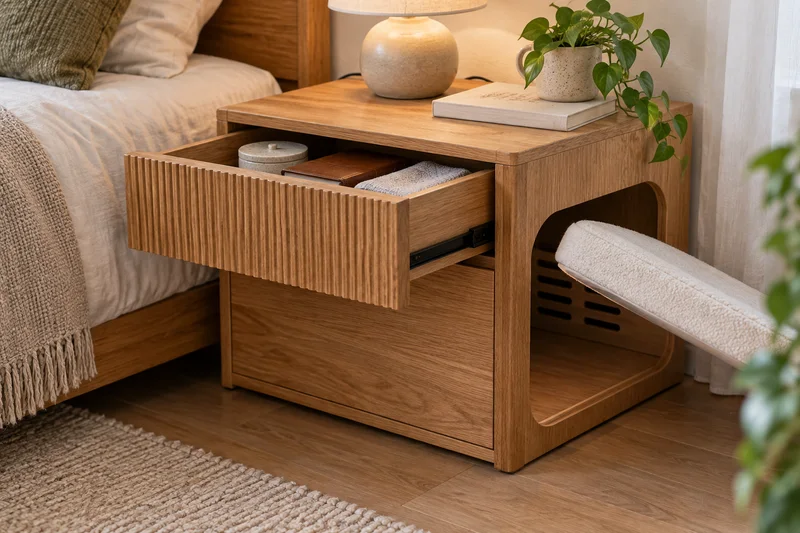
Our fluted cat perch nightstand concept pairs a textured drawer front with a side-facing resting bay. This article is a development guide for importers, brands and retailers. The lifestyle images are AI-generated concept illustrations, not photographs of manufactured samples. Dimensions, materials, construction and performance remain subject to drawing and sample approval.
Plan the bedroom position and the opening together
Start with a simple room plan showing the bed edge, headboard, wall, window, sockets and walking path. Mark the nightstand’s front and the side from which the cat enters. If that side is pushed against a wall, bedside table or curtain, the resting bay may become unusable. A left-entry and right-entry layout should therefore be treated as distinct order options unless the tested construction can genuinely be reversed.
The intended lamp position matters too. Route its cable behind the furniture and away from the pet compartment. Do not place a socket, USB outlet or loose cord where the cat lies. An integrated charging feature would add electrical components, installation instructions and market-specific evaluation; price it as a separate option rather than silently including it in the base concept.
Check the top height against the actual bed. A beautiful cabinet that sits far above or below the mattress may be inconvenient for the owner. Record the top’s usable depth for a lamp and book, plus the clear front space needed to pull out the drawer while someone is sitting on the bed.
Design the perch around usable space
Specify the clear interior width, depth and height after the drawer box, runners, base, cushion and opening frame are included. The external dimensions alone do not tell a buyer whether a particular cat can turn, settle and leave comfortably. The illustrated product listing uses a reference outer size of 600 × 450 × 620 mm; it is a concept starting point, not an approved production size or a cat-fit promise.
For a drawing example, if a 450 mm cabinet depth loses 18 mm at the front frame, 18 mm at the back panel and 30 mm for cable or construction clearance, the remaining clear depth would be 384 mm before cushion tolerances. This arithmetic demonstrates why every component must appear in the drawing; it is not a recommended interior dimension.
Ask for a plan and section view with the selected cushion in place. Show the narrowest opening, clear floor area, headroom and entry threshold. The Feline Veterinary Medical Association describes resting and elevated places as part of a cat-friendly environment, while individual preferences vary. A low perch beside a bed should be presented as one possible resting choice, not a substitute for all other safe places in the home.
| Dimension to show | Why the buyer needs it |
|---|---|
| Overall width, depth and height | Checks the room fit and bedside surface position. |
| Clear pet-bay width, depth and height | Shows space remaining after structural parts and the drawer. |
| Side opening and threshold | Confirms entry access in the installed room position. |
| Cushion finished size and thickness | Checks fit, removal route and actual headroom. |
| Drawer clear dimensions and travel | Shows usable human storage and bedside clearance. |
| Rear and side clearances | Protects ventilation and the external cable route. |
Keep the drawer and cat bay independent
A shallow drawer can preserve a practical bedside function without consuming the entire cabinet. Ask for the drawer’s clear internal dimensions, runner type, stop and removal method. Confirm that the drawer’s underside forms a smooth, finished ceiling above the pet bay. Exposed screw points, runner ends and unfinished board edges do not belong in the resting space.
Open and close the drawer on a physical sample while the cushion is installed. Movement should not shift the cushion or pinch anything in the lower compartment. A soft-close runner can be considered, but it does not prove that the whole unit is quiet; inspect the actual drawer, latch and installation tolerances. Any fluted front should remain aligned after repeated use.
Keep the drawer pull comfortable despite the vertical grooves. An integral finger recess may preserve the clean look, but its edge must be smooth and accessible. If a separate handle is used, check projection toward the bed and packaging protection.
Specify the fluted surface as a manufactured component
“Fluted oak” describes an appearance, not a production method. A machined solid-wood front, veneered grooved panel and applied battens can look similar in a rendering while differing in weight, durability, finish coverage and cost. Request a component cross-section, substrate, veneer or solid-wood specification, groove profile, radius and coating method.
Narrow grooves collect dust and pet hair. Review the sample with the intended cleaning tool and inspect the bottoms and edges of the flutes for finish consistency. Sharp or fragile ridges are especially undesirable on a drawer front that owners touch daily. Ask whether the grain and flute pattern are repeatable across a production run and how visible-face variation will be approved.
If the product uses hardwood plywood, MDF or particleboard and is destined for the United States, the buyer should confirm the applicable composite-wood requirements for the final construction. The U.S. EPA explains that finished goods containing regulated composite-wood panels fall under TSCA Title VI. A concept image or a generic “eco” label is not evidence of compliance.
Make the cushion a serviceable part
Specify the cushion’s finished outline, textile, filling, underside, closure and attachment method. It should lift out through the side opening without needing to remove the drawer or disassemble the cabinet. A removable cover can be useful, but “machine washable” should appear only when the approved fabric, filling and care instructions support that claim.
Check whether the underside slips on the selected wood finish. A non-slip layer or discreet mechanical retention may help, provided it does not create a snagging edge or complicate cleaning. The cushion must remain a replaceable accessory with a clear part number and approved dimensions. This matters to retailers managing spare parts and repeat orders.
Ventilation and cleaning must survive installation
Side and rear slots should stay open after the cabinet is placed beside a bed. A ventilation cut-out blocked by a wall or blanket contributes little to the usable arrangement. Show the required wall gap in installation guidance and avoid describing a few decorative slots as proven airflow performance.
Remove the cushion and reach the rear corners of the bay during sample review. Finish the base, lower walls, opening edge and cut-outs so they can be wiped as specified. Do not assume a coated panel makes the assembled furniture waterproof; joints and cut edges need their own review. Bedding and cleaning products should follow the materials approved for the final sample.
For a senior or mobility-limited cat, a high threshold or slippery floor may be a poor choice. The Cat Friendly Homes guidance emphasizes easy access to resting places for older cats. A lower entry or separate step can be developed for a specific target profile, with its own footprint and sample review.
Compare assembly, carton and replacement parts
A nightstand with a side opening has fewer continuous panels than a conventional closed box. Define how the top load passes through the front, rear, side supports and base. Do not infer an approved top load from the room image. If the drawer and bay ship partly assembled, compare that approach with a full knock-down pack for alignment, carton depth, damage and customer assembly time.
Ask for a packing drawing showing the fluted front, cushion, rails, hardware bag and finished panels separated from abrasion. Record packed dimensions, gross weight, carton count and whether the cushion is compressed. A thin carton is not automatically cheaper if the exposed flutes or cabinet corners are damaged in transit.
The International Safe Transit Association lists different package-test procedures by shipment situation. Select a suitable procedure with the laboratory for the actual packed unit and distribution route; a result belongs to the tested pack revision.
Sample review and quotation checklist
- Place the unit in the intended bedroom position and confirm the side opening, drawer travel and lamp cable route.
- Measure the clear pet bay, opening, threshold and headroom with the approved cushion installed.
- Check drawer function, runner access, stop and finished underside.
- Remove and reinstall the cushion, inspect its underside and clean the rear of the compartment.
- Inspect fluting profile, edge finish, coating consistency, pet-contact surfaces and ventilation cut-outs.
- Assemble and unpack the exact sales configuration using only the supplied instructions.
- Approve the drawing, bill of materials, finish sample, care instructions, carton and replacement-part list as one revision.
For an RFQ, send the bed height, maximum footprint, left or right entry preference, intended cat profile, target market, preferred drawer capacity, finish reference, cushion direction, order quantity and distribution channel. Request separate lines for sample development, tooling, textile options, packaging and replacement cushions. Fixed prices and lead times require a confirmed specification and volume.
Explore our pet-friendly nightstand range and related cat-cave nightstand concept. We support customized dimensions, materials, finishes and layouts through our design and development process. Send your brief to discuss a sample and quotation.
Frequently asked questions
Can the cat opening face either side?
It can be specified for left or right access. Confirm each version’s drawing, drawer components, assembly sequence and carton. A factory-built mirror version is different from a customer-reversible cabinet.
Does a removable cover make the cushion washable?
Only the approved fabric and care instructions can support that claim. Verify the wash method and dimensional stability on the selected textile before publishing a care promise.
Is the reference size a finished specification?
No. The reference outside dimensions and generated images describe a development direction. Final interior clearances, performance, packaging and availability follow the approved sample.