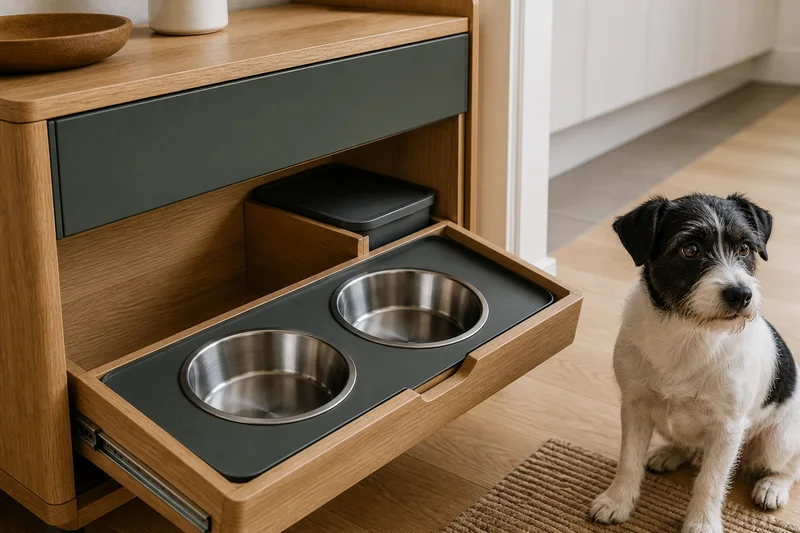
A pull-out feeding station can turn a necessary pet routine into a calm, furniture-led part of the home. When closed, it may read as a slim hallway console, kitchen cabinet or sideboard; when opened, it presents a defined bowl tray at the intended location. The useful product question is not simply whether two bowls fit in a drawer. It is whether the bowls, tray, drawer, storage and surrounding finished surfaces can be specified, used, cleaned, packed and assembled as one coherent furniture system.
For brands, importers and retailers, this category works best when it respects both the human room and the owner’s actual routine. It should make the bowl set easy to remove, keep loose hardware away from the feeding surface, allow a practical cleaning route and avoid unsupported health claims about feeding height, portion control or pet suitability. This guide lays out the decisions that should be agreed before a supplier costs the design or makes a sample.
Start with the room role, then define the feeding routine
First decide where the piece belongs. A shallow entry console has different limits from a kitchen-side cabinet or a living-room sideboard. Record the maximum width, depth and height; wall, door and walking clearances; nearby flooring; and whether a drawer left open would cross a main route. A furniture photograph is not a substitute for this plan. If the product is intended to sit in a narrow hallway, its open drawer depth and pull-out direction are commercial requirements, not late-stage details.
Next, define the feeding routine. Is the tray brought out only at meal times, left open for water, or used for two bowls at a fixed location? Is there a separate place for dry-food storage, treats, scoops or leads? Are buyers expected to remove bowls one by one, lift out an entire tray insert, or wipe a fixed surface? These choices affect the drawer front, handle, tray lip, runner selection, internal divider and instruction sheet. They should never be hidden behind a generic “smart feeding cabinet” label.
1. Develop the bowl tray as a removable service part
The bowl tray is the part most likely to be handled, wiped and seen at close range. The drawing should specify the bowl count; bowl-seat diameter and depth; removal direction; tray material; edge height; finger access; whether bowls sit on a removable insert or directly in a cut-out panel; and the clearance to the drawer front and cabinet sides. A bowl that is hard to lift out, rattles in transport or leaves an unreachable dirty edge will create an avoidable service problem.
Do not write care claims before the component has been approved. The U.S. Food and Drug Administration advises owners to wash pet food bowls and scooping or measuring utensils with soap and hot water after each use, and to use a clean scoop rather than a food bowl as a measuring utensil. A furniture brief should therefore make a sensible route for removing bowls and any tray insert. It does not turn the cabinet into a hygiene certification or guarantee an owner’s cleaning routine.
2. Separate wet-use surfaces from the furniture finish
Feeding areas may experience water drips, bowl movement and repeated wiping. That calls for a component-level specification: finished timber or engineered-wood cabinet; tray insert material; bowl material; perimeter edge; sealing approach; and the relationship between the removable service surface and visible veneer, laminate or painted faces. “Waterproof” should not appear in buyer-facing copy unless the exact component, test method and intended use have been established. In most development briefs, a more accurate promise is an easy-to-remove tray or insert with a defined cleaning method.
Keep the food-storage area separate from the bowl drawer unless the design explicitly defines an internal bin, lid, access route and cleaning responsibility. FDA guidance also says dry pet food should be stored in a cool, dry place and kept secure. The furniture product can offer an organized storage location; it should not imply that an unventilated cabinet automatically preserves every food type or replaces the food manufacturer’s storage instructions.
3. Specify the drawer and runner for the actual assembled tray
A feeding drawer is not the same as a stationery drawer. The approved configuration includes the bowls, tray, any food or water, the drawer bottom, front panel, runner, screws and stop mechanism. State the intended service load, the drawer travel, whether the tray needs to sit level in the open position, and how the user avoids catching fingers while closing it. Runner grade, fixing locations and pull-out distance should be selected for the confirmed product—not copied from a shallow accessory drawer.
Review the sample in routine positions: fully closed, partly open, fully extended, bowls removed and tray reinserted. Check whether the drawer front clears a rug, whether a person can reach both bowls, whether a small pet can approach without an unstable-looking tray, and whether the open drawer blocks the planned route through the room. These are observation points for product development, not a claim that the concept suits every animal or home.
4. Make storage useful without turning it into a catch-all void
One advantage of a care console is that it can organize a small, defined set of pet supplies. A top drawer may hold a dedicated scoop and treats; a lower compartment may hold a removable dry-food bin; side hooks may hold leads. Give each compartment a stated purpose, internal volume, access direction and hardware plan. A deep cabinet with no bin, divider or cleaning route is not necessarily useful food storage merely because a food bag fits inside it.
For a bin or container supplied with the cabinet, specify its material, lid, removal path, handhold, food-contact status where relevant, cleaning direction and replacement-part availability. If the product does not supply a container, say so. This clarity lets a buyer compare quotations fairly and prevents lifestyle photos from implying accessories that are not included in the final offer.
5. Keep the human furniture value visible
The best examples remain credible home furniture when the feeding tray is closed. A slim cabinet can provide an entry surface, a drawer for household items, a small plant or a place to put keys. Its panel proportions, handles, finish, feet and top overhang should be developed with the same care as the pet function. If the cabinet only looks balanced with the drawer open, it is not yet a strong furniture proposition.
Define the exterior from normal viewing positions. Choose whether the drawer front is flush, framed, fluted or rattan-accented; whether the hardware is visible; and how any bowl-tray seam is concealed. Request finish chips and an assembled sample under real interior light. Colour names alone do not confirm veneer grain direction, paint sheen, edge treatment or the way a removable tray contrasts with the cabinet front.
6. Build a traceable bill of materials
A quotation should separate cabinet panels, visible finish, edge treatment, tray insert, bowls, bowl retainers, runners, drawer box, handles, feet, screws, food bin, hooks and packaging. This protects the buyer from comparing unlike quotations and makes it easier to develop replacement parts. It also identifies which pieces need contact with moisture, which are visible on arrival and which are packed against finished faces.
For products supplied to the United States, the U.S. Environmental Protection Agency identifies hardwood plywood, MDF and particleboard as regulated composite wood products under TSCA Title VI. The buyer and supplier must confirm applicable documentation, certification and labeling for the final materials and destination market. A general “eco-friendly” statement is not a substitute for traceable panel and finished-goods information.
7. Flat-pack around surfaces that must arrive clean and aligned
Flat-pack can reduce shipping volume, but the feeding-tray assembly has finished faces, bowls, runners and removable inserts that need coordinated protection. Separate metal bowls and hardware from visible panels. Prevent runners or screws from rubbing a painted drawer front. Give the bowl tray its own protective layer so a sharp insert edge cannot mark a veneer top during transit. The carton plan should state which parts are assembled, which parts are installed by the customer and where the hardware pack appears in the sequence.
Test the instructions with someone who did not design the cabinet. They should be able to identify left and right runners, orient the drawer box, install any tray retainer, place the bowls and understand what is removable for cleaning. For parcel delivery of individual packaged products of 150 lb (70 kg) or less, ISTA Procedure 3A is a general-simulation procedure intended for that shipment type. The final test plan, samples and acceptance criteria must match the confirmed carton and route; a result does not automatically apply to every configuration.
Use three approval gates
| Gate | Decision | What to review |
|---|---|---|
| Concept and quotation | Is the furniture and feeding brief clear enough to cost? | Room role, overall footprint, bowl count, tray concept, storage plan, finish direction, target quantity and price. |
| Functional sample | Can the owner operate and clean the confirmed parts? | Bowl removal, tray edges, drawer travel, runner operation, accessible wiping, storage-bin route, floor contact and visible finish. |
| Packed pre-production sample | Is the sellable product specification complete? | Approved bill of materials, bowl and tray parts, instructions, hardware bags, carton protection, labels and inspection points. |
What to include in a quotation request
- Reference images or sketch, installation room, maximum width/depth/height and clearance needed with the tray open.
- Intended pet type and routine, without asking the supplier to make universal suitability claims.
- Bowl number, required bowl-seat size, removable-bowl and removable-tray direction, and cleaning expectation.
- Cabinet storage plan for food bin, scoop, treats, leads or other supplied accessories.
- Panel substrate, finish, tray material, bowls, runners, handles, feet, destination market and target quantity.
- Flat-pack requirement, target carton count, retail channel, instructions, inspection criteria and any package-test requirement.
Frequently asked questions
Can the feeding drawer stay open all day?
That depends on the confirmed room location, intended water or food routine, drawer configuration and household. The product specification should state the intended use rather than implying that an open drawer is appropriate in every home.
Should bowls sit directly in a wood drawer?
A development brief can instead specify a removable tray or insert, bowl seats, edge treatment and a cleaning route. The selected materials and construction should be approved on the functional sample.
Can a feeding station ship flat-packed?
Yes, when the drawer box, runners, bowl tray, bowls, hardware, part labels and visible-face protection are developed as one packing system.
Where can I view related product directions?
Explore our pet entryway furniture range, including the pet care console with feeding drawer, shoe cabinet with pull-out feeding station and mudroom locker bench with pet nook. For a tailored program, see our development process or send a product brief.
Sources: U.S. Food and Drug Administration pet-food safe-handling guidance; U.S. Environmental Protection Agency TSCA Title VI composite wood product FAQ; and International Safe Transit Association test-procedure overview. This article is a product-development guide, not nutrition, veterinary, safety, certification or legal advice. Final dimensions, materials, drawer construction, bowl components, cleaning directions, packaging and market requirements must be confirmed for the actual product before production.