A furniture-style dog crate has to earn its place in two ways. For the owner, it needs to look and function like a well-proportioned console, end table or bench. For the dog, it needs to provide an appropriate, ventilated and practical resting space. Combining those two jobs is more demanding than placing a standard crate behind decorative panels. The opening, internal clearances, door operation, cleaning route, board construction and shipping carton all change the product-development brief.
For brands, importers, retailers and wholesalers, the objective is not to copy a fashionable image. It is to turn a home-furniture concept into a clearly specified product that can be quoted, sampled, assembled and shipped consistently. This guide explains the decisions to settle before approving a furniture-style dog crate or asking for a production quotation.
Start with the intended dog and the intended room
“Medium dog crate” is not an engineering specification. The buyer should state the target dog profile, including expected body length, shoulder height, approximate weight range and whether the product is for an adult dog or a growing puppy. The supplier then needs to show the usable internal dimensions after board thickness, frame rails, cushion, door construction and removable tray have been allowed for.
As a practical welfare baseline, the American Kennel Club advises that a crate give a dog enough room to sit, stand and lie down comfortably; its crate-training guidance also emphasizes ventilation and that a crate should be a positive resting place rather than punishment. That principle is useful for product briefing, but it is not a universal dimension chart. A buyer should not approve an external cabinet size until the actual inside length, width, head clearance and entrance dimensions are documented for the selected dog profile.
Room context matters as well. A crate used beside a sofa may need to function as an end table; one used at the foot of a bed may need a low profile; an entryway model may need a bench-height top and a place for shoes or leads. These decisions affect the top load, overall footprint, door swing and hardware route.
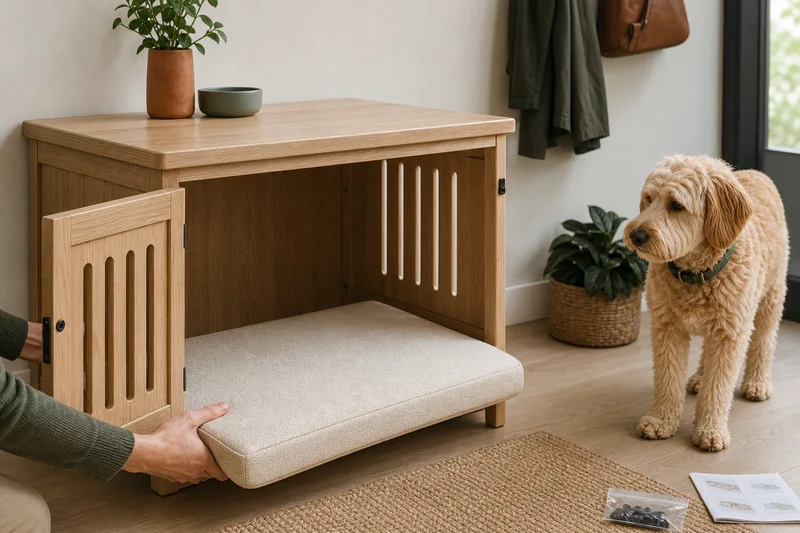
1. Measure the usable interior, not the outside cabinet
Ask for a dimensioned drawing with both exterior and interior measurements. The internal space should be shown with the cushion in its normal position and the door fully open. A deep-looking cabinet can lose a surprising amount of space to thick top panels, a rear rail, a raised base, door framing or a mattress.
The entrance also needs its own dimensions. A dog may be able to turn inside a compartment but still hesitate at a narrow or low opening. Door thickness, handle projection and a threshold rail can reduce the usable entry further. If the product is intended for more than one dog size, create separate SKUs or a controlled size range instead of making an undefined “one-size” claim.
2. Design ventilation as part of the structure
Ventilation should be considered with visibility, cleaning and panel strength—not added as a decorative pattern after the cabinet is complete. Common routes include spaced wood slats, metal side panels, elongated slots or an open front behind a door. Each solution changes the machining, finishing time, frame rigidity and perception of the product.
Review the crate with the door closed, the cushion installed and the cabinet against a wall. Check that ventilation openings are not blocked by a rear panel, stored objects or fabric. The design should also avoid raw cut edges or narrow apertures that are difficult to sand, coat or inspect. The final opening geometry, spacing and construction should be confirmed on the approved sample for the intended dog profile.
3. Treat the door as a furniture component and a pet-use component
A crate door must look integrated with the cabinet while operating reliably in daily use. Decide early whether the design uses a hinged front door, double doors, side access, a sliding door or a removable panel. The choice determines the required clearance in the room and how the product can be packed flat.
During sample review, open and close the door repeatedly with the cushion installed. Check handle reach, latch engagement, hinge alignment, door sag and the gap between the door and surrounding frame. Any accessible fastener, sharp edge or loose latch detail should be corrected before a production specification is released. If a model uses two doors or a divider, test each configuration separately instead of assuming the hardware will behave identically.
4. Specify pet-contact materials and destination-market requirements
“Wood finish” is too vague for a dog-crate cabinet. The bill of materials should identify the board substrate, veneer or laminate, solid-wood elements, edge banding, coating system, adhesive-dependent parts, hardware finish and cushion materials. It should also identify which surfaces are inside the pet compartment and which are primarily decorative exterior faces.
Requirements depend on the actual materials and destination market. In the United States, the EPA identifies hardwood plywood, medium-density fibreboard and particleboard as regulated composite wood products under TSCA Title VI, and the rule also covers finished goods containing those regulated panels. That does not make every wooden crate automatically compliant: the buyer and supplier need to verify the material route, applicable records, labels and certification requirements for the finished product being sold. Similar market-specific review may be needed elsewhere.
5. Make the interior easy to clean and maintain
A removable cushion, mat or tray can make an attractive product more practical in real homes. But “removable” needs a method. Confirm how the part is lifted out, whether a customer can reach the rear corners, how fabric covers are cleaned, and whether replacement components can be ordered and packed without damaging the furniture.
Use the sample to check the real cleaning path. Can a hand reach the back panel? Does the cushion catch on the door frame? Can a tray be removed without turning the cabinet on its side? Are seams, edges and joins sealed or otherwise specified for the intended use? A photogenic interior is not automatically a maintainable interior.
6. Engineer the top surface and base for furniture use
The human-facing top surface often receives lamps, books, decor or a television, depending on the model. That means the crate enclosure cannot be treated as a decorative shell. The top, side panels, rails, back and base need a load path that suits the actual furniture function. A console intended to support media equipment has different needs from a small end table.
List the anticipated top use, drawer contents and any required load or stability checks in the product brief. If the model has legs, verify that the base remains stable on realistic floor conditions and that the crate door does not conflict with rugs or skirting boards. A model that is wide, tall or top-heavy may need a different construction or market-specific restraint guidance; this should be determined by the actual design and sales requirements rather than copied from an unrelated cabinet.
7. Plan flat-pack construction from the first drawing
Furniture-style dog crates are often attractive to ecommerce and export programs because knock-down construction can reduce shipping volume. That benefit disappears if the end customer receives too many similar panels, unclear hardware or a difficult order of assembly. The panel breakdown should be designed alongside the door system, base frame and ventilation panels.
Ask these questions before sampling:
- Which components ship assembled, and which are customer-installed?
- Can a customer identify the left, right, front and rear panels without guesswork?
- Are connectors reachable after the door and internal panel are installed?
- Does the hardware kit include only the tools and fasteners actually required?
- Can the door be aligned without forcing the cabinet out of square?
- Does the instruction sequence reflect the way the sample is actually assembled?
A useful check is to ask a person who did not design the product to build the sample using only the proposed instructions. Their hesitation points often reveal a better panel label, connector position or assembly step.
8. Match packaging to the distribution route
Define whether the crate will travel as a parcel, on a pallet, through less-than-truckload distribution or in a full container. Finished wood faces, long slatted parts, doors, hardware bags and cushions each need different protection. Corner protectors, foam, paper wrap, panel spacing and internal restraints should be reviewed with the packed sample rather than added only after a damage claim.
For individually packaged products shipped through a parcel system at 150 lb (70 kg) or less, ISTA Procedure 3A is one commonly referenced general-simulation protocol. It includes transport hazards such as vibration, drops and conditioning. The applicable procedure and pass/fail criteria still depend on the actual packaged product and distribution route. A laboratory simulation is evidence for the tested pack configuration; it is not a universal guarantee against every shipping event.
Use a three-stage sample plan
| Stage | Primary question | Typical review points |
|---|---|---|
| Fit and layout mock-up | Does the dog and room use make sense? | Internal space, entrance, door swing, top height, general proportions |
| Engineering sample | Can the furniture be built, used and assembled as intended? | Materials, hardware, ventilation, edges, removable parts, knock-down joints |
| Pre-production / packed sample | Is the approved specification ready for the confirmed order? | Finish standard, quality points, instructions, carton, labels and distribution test plan |
Keep the approval language precise. A concept may be approved for quotation without being approved for a physical sample. A physical sample may be approved subject to a documented change. Production should only proceed against a controlled drawing, bill of materials, finish reference, hardware list, instruction version and packaging specification.
What to include in a request for quotation
- Reference photos or a sketch, plus the intended furniture role: end table, console, nightstand or bench.
- Target dog type and usable internal dimensions—not only the outside size.
- Door configuration, ventilation direction and removable cushion or tray requirements.
- Board, veneer, solid wood, coating, hardware and fabric direction.
- Destination market, estimated quantity, target retail or landed-cost position and timing.
- Flat-pack preference, expected shipping channel, carton constraints and required test protocol.
- Any retailer, regulatory, labeling, inspection or document requirements.
Frequently asked questions
Can one furniture-style dog crate work for every dog?
No. The relevant measure is the usable internal space and entrance for the intended dog profile. A range can share a visual platform, but each size should have its own controlled dimensions and construction review.
Can a dog-crate console be supplied flat-packed?
Yes, provided that the connector system, panels, door alignment, hardware kit, instructions and carton protection are developed together. A flat-pack drawing is not enough; the intended assembly must be tested on a physical sample.
Is a concept rendering enough to begin production?
No. A rendering can help define appearance and functions, but it does not verify internal dimensions, material route, door operation, stability, assembly or packaging. These details need drawings and sample review.
Where can I start with an existing product direction?
Explore our dog crate furniture directions, including the double-compartment dog crate console and corner dog crate end table. For a custom brief, see our product development process or send your project requirements.
Sources: American Kennel Club crate-selection and crate-training guidance; U.S. Environmental Protection Agency TSCA Title VI composite wood product FAQs; and International Safe Transit Association Procedure 3A overview. This article is a product-development guide, not a certification statement or a substitute for destination-market legal, safety, welfare or laboratory advice. Final requirements must be confirmed for the actual product, materials, target dog profile, market and distribution route.