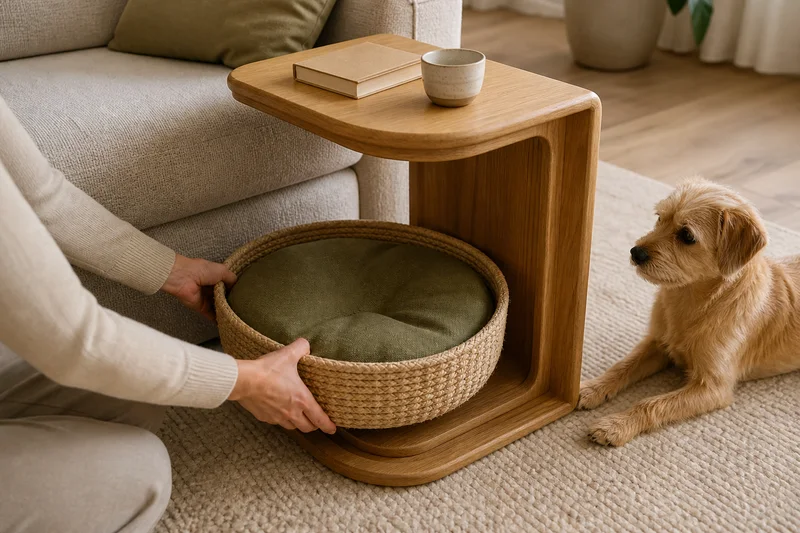
A pet side table looks simple at first glance: a small surface for a book or cup, with a resting space below. In product development, however, it has to solve two different routines in one small footprint. The owner expects a useful table beside a sofa or chair. The pet needs a resting area that is accessible, comfortable, cleanable and appropriate to the intended size range. A removable basket adds another layer: it can make the resting zone more approachable and easier to service, but only if the basket, cushion, frame and packaging are designed as one system.
For brands, retailers, importers and hospitality buyers, the objective is not to put a pet bed under any occasional table. It is to develop a living-room item whose furniture use, pet use and supply-chain requirements are all clear before the first sample. This guide explains what to define for a pet side table with a removable basket bed, from the buyer brief to packed-sample approval.
Begin with the two-user brief
Write down the owner-side function before styling the pet zone. Is the top intended for a drink, a reading light, a laptop, a book, or simply a decorative object? Does it slide under the sofa edge as a C-shaped table, stand beside an armchair, or work as a compact bedside table? These choices determine table height, top size, base shape, balance and carton dimensions.
Then define the pet function. A removable basket can serve as a low resting bed for a cat or a defined small-dog profile. It should not be marketed as suitable for every pet merely because it is open. Record the target animal profile, intended usable basket dimensions, cushion thickness, entry height and whether the basket is expected to be lifted out routinely. The external table dimensions do not describe the actual resting space.
1. Measure usable pet space, not only the outside silhouette
A rounded basket, an upholstered cushion and a timber frame all reduce usable space. The development drawing should show the basket’s inner diameter or inner width and depth, usable internal height, cushion compressed height and the clear route for the pet to enter and leave. If the basket sits inside a timber base, note any rim or front rail that changes the effective entry height.
Do not use a generic “small pet” label as a sizing specification. The buyer should state the intended animal range and check the physical sample with that use case. Larger animals, pets with limited mobility and individual sleeping preferences may call for a different entrance, basket shape or product family. The right claim is a defined design intent, validated through sample review—not a universal promise.
2. Give the basket a genuine removal and cleaning route
The removable basket is the product’s service feature, so it must be removed in a normal home without dragging it across finished wood or moving the whole table. Confirm where hands grip the basket, whether the cushion shifts during lifting, whether the rim catches on the frame and where the basket is placed while the owner cleans the floor or cushion.
Specify the basket material, weave or moulded construction, rim finish, cushion cover, filling, closure and underside. If a cover is described as removable or washable, confirm this only after the actual textile and care method are tested and approved. A useful product program can also include a replacement cushion or replacement basket, but those should be costed as real service parts with defined dimensions and material consistency.
3. Keep the owner-side table function visible
A pet side table earns its place in a living room when the top remains practical. A C-shaped model may need to slide close to a sofa while leaving enough room for an owner’s feet and normal cleaning. A drum-style side table may need a stable top and a clear line between the drawer or storage zone and the lower pet opening. The product drawing should show top height, usable top depth, base footprint, sofa-clearance assumption and access to any drawer or basket.
Test the table with the everyday objects it is expected to hold. A large mug, reading lamp or book can reveal a top that is visually attractive but too small or too close to the sofa arm. Conversely, a top extended too far beyond a light base may change the stability requirements. Do not copy a load claim from a different occasional table; the final construction and any test requirement must match the actual design and intended use.
4. Plan the pet zone as a separate, calm resource
For cat-oriented versions, veterinary guidance recommends giving each cat a safe resting place and separating key resources such as resting, food, water and toileting areas. The FelineVMA environmental-needs guide also notes that a cat that feels threatened benefits from being able to enter and leave a safe space from more than one side. That does not mean a small side-table basket must be designed as a universal safe-space solution. It means the buyer should consider the actual room, other pets, traffic and intended use instead of treating one basket as a substitute for every cat resource.
For a small-dog version, the same commercial principle applies: do not position a resting area where it is repeatedly blocked by a drawer, a chair leg or a busy circulation route. A low basket placed beside the sofa can be a practical direction, but the physical sample should be reviewed in the intended setting with the expected user routine.
5. Specify materials by component and destination market
“Wood and basket” is not a production specification. Break the product into its components: solid wood, veneer, plywood or engineered panel; edge treatment; coating; woven fibre or basket body; cushion textile and filling; non-slip feet; fasteners; and any drawer runners. Finished surfaces, the pet-entry edge, the basket rim, the underside and floor-contact points deserve distinct review because they receive different types of wear.
For products sold in the United States, the EPA identifies hardwood plywood, MDF and particleboard as regulated composite wood products under TSCA Title VI. Finished goods containing those regulated panels may also be subject to the rule. The final material route, documentation, certification and labeling requirements must be confirmed for the actual product and market. A concept visual or a broad “eco-friendly” statement is not compliance evidence.
6. Resolve balance, contact points and movement on the sample
A side table with a basket bed has multiple shifting conditions: the basket may be empty, occupied, pulled out, set down on the floor or returned to its base. The engineering review should consider the chosen base footprint, vertical members, top overhang, table location and the intended user action. Review the finished sample on the relevant floor surface and do not infer a stability result from a rendering.
Inspect every daily-contact zone: outer corners, basket rim, cushion zip placement, underside, base corners, fastener covers and any drawer pull. They should be smooth and consistently finished, without exposed staples, protruding screws or unfinished panel edges. Where felt pads or non-slip feet are included, define their material, location and attachment rather than leaving them as an informal factory choice.
7. Design flat-pack assembly around the basket, not despite it
A removable basket can simplify the customer experience because it may be packed separately and placed into the frame after assembly. The frame itself still needs an intuitive panel and hardware sequence. A C-shaped construction may include a top, upright, base, reinforcement, feet and hardware pack; a round table may include a curved shell or separate slats, base, drawer components and basket.
Label similar-looking parts, keep connector access clear and ensure the customer does not need to hold a large top while aligning hidden fittings. The instruction sheet should show when the basket and cushion are introduced. Ask someone who did not develop the product to assemble the pilot sample using only those instructions. Their hesitation points expose opportunities to improve the part design, packing order and manual before production.
8. Pack the table and basket as separate protected components
Visible wood edges, a woven rim, cushion fabric and hardware should not compete for the same unprotected space in a carton. The packing plan should prevent the basket from rubbing against finished faces, isolate the hardware pack from panels and keep the cushion clean and dry. If the basket can deform under compression, define its internal support and the maximum permitted stacking or vacuum-packing method before the pack is approved.
For individual packaged products distributed through a parcel system at 150 lb (70 kg) or less, ISTA Procedure 3A is one commonly referenced general-simulation procedure for hazards such as vibration, drops and conditioning. The correct procedure, sample count and acceptance criteria depend on the final product, carton and distribution route. A pass result applies to the tested pack configuration, not every possible delivery event.
Use three approval gates
| Gate | Decision | What to review |
|---|---|---|
| Concept and quotation | Is the two-user layout commercially viable? | Table function, target pet profile, usable basket space, room placement, material direction, target price and carton assumption. |
| Functional sample | Does the product work in daily use? | Basket removal, cushion access, table-top function, floor contact, room clearance, edges, construction and assembly sequence. |
| Pre-production / packed sample | Is the released specification complete? | Approved materials and finish, service parts, hardware, instructions, labels, protective packing and inspection points. |
What to include in a quotation request
- Reference image, sketch or target styling direction, plus maximum external width, depth and height.
- Primary owner use: sofa-side table, reading table, bedside table or hotel-room occasional table.
- Target pet profile and required usable basket dimensions, opening height and cushion direction.
- Preferred frame material, finish, basket material, textile and visible hardware details.
- Whether replacement cushions or baskets are required as service parts.
- Destination market, estimated quantity, target price range, flat-pack requirement and shipping route.
- Any retailer testing, inspection, labeling or carton-size requirements.
Frequently asked questions
Can a removable basket side table be developed for cats and small dogs?
It can be developed for a defined target animal profile. Usable internal basket space, entrance height, cushion thickness and room placement should be reviewed for the intended use rather than described as universal.
Can the basket and cushion be replaced after purchase?
Yes, if the finished dimensions, material route, fixing method and service-part specification are agreed during development. The physical sample should verify that replacement does not damage the table finish.
Can this type of furniture ship flat-packed?
Yes, when the table frame, basket protection, hardware pack, customer assembly order and carton are designed and verified together.
Where can I view related product directions?
Explore our pet side table range, including the C-shape pet basket side table, universal pet bed side table and round slatted pet bed side table. For a custom program, review our development process or send a product brief.
Sources: FelineVMA environmental-needs guidance, U.S. Environmental Protection Agency TSCA Title VI composite wood product FAQ and International Safe Transit Association test-procedure overview. This article is a product-development guide, not a certification, safety or legal statement. Final dimensions, materials, construction, care instructions, packaging and market requirements must be confirmed for the actual product before production.